People come to Dharamshala for many reasons. Yoga is often one of them -but usually not just for exercise.
There’s something about being here that shifts your attention. The mountains, the air, the rhythm of the day. Things move a little slower. Even the pauses feel different.
You might arrive with a clear intention, or just a sense that you want to explore something more- not necessarily in a defined way.
And then you start looking for a class.
In places like Dharamkot, options are everywhere. Small studios, drop-in yoga classes, courses, teacher training- all within walking distance. It doesn’t take long before the choice itself becomes overwhelming.
So the question becomes simple:
How do you choose the right yoga for you in Dharamshala?
What to Expect?
Yoga in Dharamshala isn’t one thing.
You’ll find flowing classes, strong physical practices, slower sessions, breath-based work, meditation-focused approaches. Many teachers pass through, each offering something slightly different.
This variety is part of what makes practicing here interesting. You can explore, try different styles, and see what resonates.
But after a while, many people start looking for something more consistent — not just a new class each day, but a way of practicing that builds over time.
If you’re new to yoga in Dharamshala, it can help to begin with a simple overview
Why Dharamshala and Dharamkot Is a Unique Place to Practice Yoga
Dharamkot has its own rhythm. Mornings are quiet. The paths are uneven, sometimes steep. You pass cafés opening for the day, people heading to practice, others just sitting with tea.
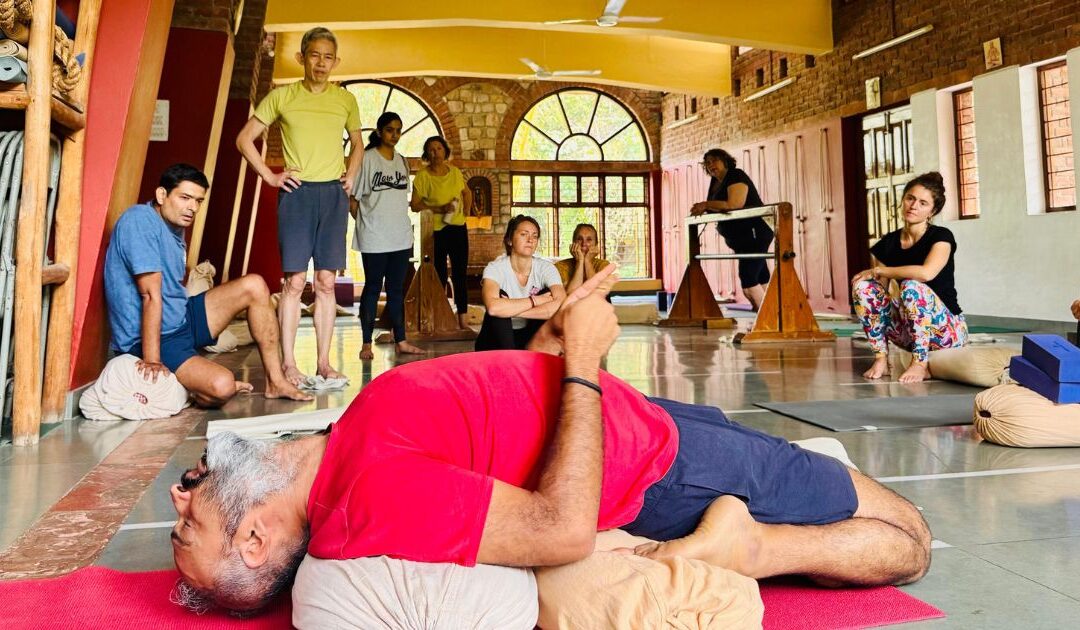
You might arrive at your yoga class already slightly warm from the walk. Inside, the space is simple. Mats, neatly stacked props — blocks, belts, blankets. Maybe a wall for support. Nothing excessive. Outside, the mountains are always there, even when you stop paying attention to them.
It’s a place where it’s easy to slow down. But also easy to drift — to move from one yoga class in Dharamshala to another without really staying long enough to understand what you’re doing.This is where the approach you choose starts to matter.
What Makes Iyengar Yoga Different
Iyengar yoga is steady. It doesn’t depend on speed or constant movement. You stay in a pose long enough to understand it. At first, this can feel unfamiliar. In something as simple as Tadasana (standing), you might be asked to place your feet carefully, spread the toes, lift the inner arches, and balance your weight evenly. It sounds basic, but most people haven’t actually worked like this before.
Or in Trikonasana (triangle pose), what feels like a complete pose might reveal small imbalances -the front leg softening, the spine shortening, the weight shifting unevenly. A small adjustment changes the whole experience.
These are not big movements. But they require attention. Props are used throughout Iyengar yoga classes — not as a sign of limitation, but as tools for understanding. A block can bring the ground closer so the pose stays aligned.
A belt can show where the arms or legs should be working. A blanket can support the body so you can stay longer without strain.
You don’t move on quickly. You stay, adjust, observe, and refine. Over time, this builds:
- steadiness in the body
- clarity in action
- the ability to stay present without needing constant change
If you want a deeper explanation of this method: → https://iyengaryog.com/blogs/7-reasons-to-choose-iyengar-yoga-in-dharamkot
What an Iyengar Yoga Class Feels Like
If you’re new to Iyengar yoga in Dharamshala, it helps to know what to expect. Classes usually begin with standing poses. These form the foundation — building strength, stability, and awareness.
The teacher demonstrates. Then you practice. Then adjustments are made. Sometimes the whole class works on the same pose together. Sometimes you repeat it. There is instruction, but also space to observe.
You might use the wall for support. You might stay in a pose longer than you’re used to. There is less variety, but more depth. The class may move into seated or supported work, and usually ends with rest.
It’s not about how many poses you do, but how you do them.
From Class to Personal Practice
One of the more important shifts happens outside the class. After a few Iyengar yoga sessions, you start to remember what you’ve done.
You might notice:
- one side of the body works differently
- certain actions are harder to maintain
- some poses you tend to avoid
Instead of always looking for something new, you begin to repeat what you’ve already learned. This is where the practice becomes your own.
You don’t need a long sequence. A few poses, done with attention, are enough. You stay with them. You work them out. You come back the next day and see what has changed- or what hasn’t. It’s not always comfortable. But this is where understanding develops.
You can explore this further here: → https://iyengaryog.com/blogs/from-class-to-self-practice-deepening-your-iyengar-yoga-journey
Is Iyengar Yoga Good for Beginners in Dharamshala?
Yes, and in many ways, it’s one of the clearer places to begin. You’re not expected to know anything in advance. The poses are explained step by step. There is time to adjust, to ask questions, and to try again.
- You don’t need flexibility.
- You don’t need strength to start.
- You don’t need prior experience.
What matters more is your willingness to pay attention. Many people looking for beginner yoga in Dharamshala find this structure helpful — especially when everything else around them feels new.
If you want to join a class: → https://iyengaryog.com/iyengar-yoga-drop-in-classes-dharamsala-studio-sessions/
Who Iyengar Yoga Tends to Suit
Iyengar yoga tends to suit people who want to understand what they’re doing — not just move through it. It can be especially useful if you:
- prefer clear instruction
- want to build a practice you can continue on your own
- are working with stiffness or imbalance
- are willing to stay with something and work it out
At the same time, it requires patience.
If you’re looking for constant movement, it may feel slow at first. But for many, that’s where the depth comes from.
You don’t move on until you understand.
Choosing the Right Yoga Classes in Dharamshala
With so many options for yoga in Dharamshala, it helps to simplify the decision. Instead of asking:
“Which class looks the most appealing?”
You might ask:
- Will I understand what I’m doing?
- Is there attention to detail?
- Can I continue this practice on my own?
In Dharamkot, it’s easy to try many yoga classes. But real progress usually comes from staying with one approach long enough for it to settle. The right place won’t feel like something you need to keep up with. It will feel like a space where you can work, observe, and gradually understand.
Explore classes here: → https://iyengaryog.com/iyengar-yoga-classes-in-dharamkot/
A Different Kind of Yoga Experience in Dharamshala
Dharamshala has a way of quieting things down. You notice it in the mornings, in the space between activities, in how the day settles earlier than expected. Iyengar yoga fits naturally into that environment.
- You’re not trying to perform.
- You’re not trying to get somewhere quickly.
You’re standing, adjusting your feet, extending your legs, observing your breath- often in very simple poses. It doesn’t always feel dramatic. Often, it’s quite ordinary.
But something shifts -in how you stand, how you use your body, how you pay attention. And that stays with you, whether you continue practicing in Dharamshala or take it somewhere else.