
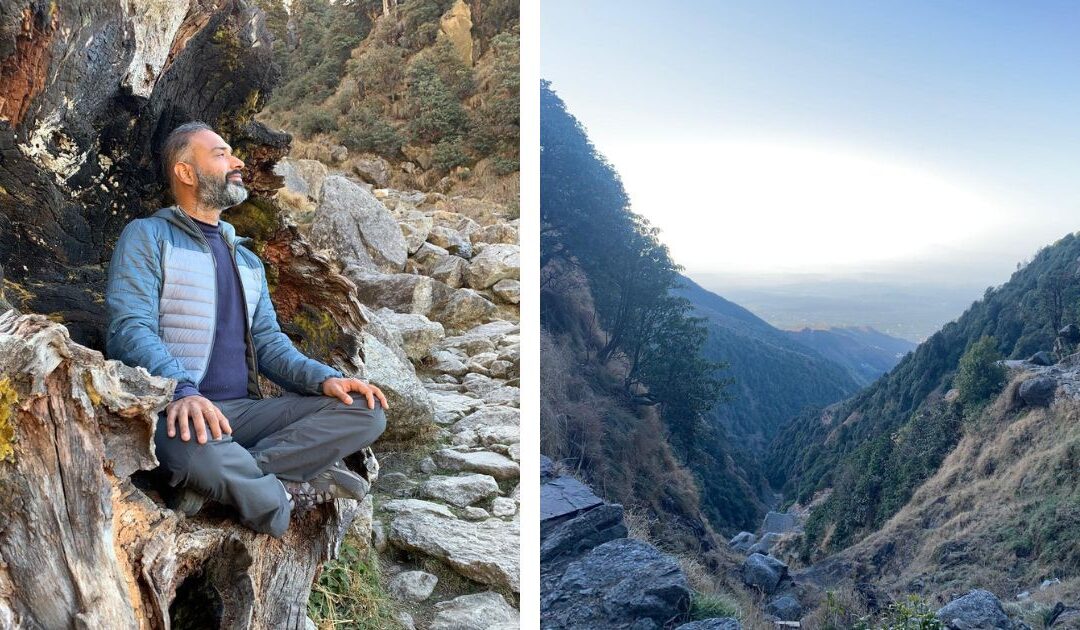
Finding Stability in the Peaks: Practicing Iyengar Yoga in the Himalayas
Here’s a reason people have always gone to the mountains to figure things out. Long before yoga studios or wellness retreats existed, early yogis and rishis headed up into the Himalayas looking for one specific thing: absolute quiet.In the high-altitude silence, far removed from the noise of civilization, they found a natural laboratory for the human spirit.
It’s the same profound quiet that anchors the deep Buddhist traditions here. If you’ve ever sat in meditation at a place like in Tushita, or sat through the intense silence of a Vipassana retreat, you know exactly what I mean. The landscape here does half the heavy lifting for you. When you are surrounded by the stillness of the peaks, the internal noise naturally begins to settle.
So, where does a practice like Iyengar Yoga fit into all this stillness?
1. The Mountain and the Mat
It really comes back to Tadasana-Mountain Pose. In our practice, we spend so much time trying to find true stability. We learn to root down firmly so we can extend upward. When you practice here, you literally have the world’s most massive, immovable mountains right outside the window showing you how it’s done.
2. Precision in the “Slow-Mo”
Everything moves a bit slower above 6000 feet. You have to be more deliberate. Iyengar yoga is perfect for this “slow-motion” world because it’s all about the tiny details. You aren’t just throwing yourself into a flow; you’re staying. You’re noticing the spread of your toes and the lift of your kneecaps. The mountains demand your absolute attention, and the mat gives you a specific place to put it. When that focus becomes unbroken, the movement stops being an exercise and starts being a gateway to that deep, Himalayan silence.
3. The Architecture of Your Own “Inner Temple”
Think about the temples tucked into these ridges. They’ve survived centuries of mountain weather because their foundations are solid. In our practice, we’re doing the same thing. We are building a structure so that even when circumstances get difficult, we can stand firmly and stay unaffected. To me, a strong structure is just another word for resilience. You start to treat your body with the same respect as the ancient stone walls around you.
The Takeaway: Carrying the Mountain Home
When you eventually head back down from the peaks and roll up your mat, you realize you’re carrying a piece of that mountain stability in your spine. You’ve learned that quiet isn’t just something you find in a remote valley. It’s a state of being you build, muscle by muscle, bone by bone and breath by breath.
Join Us: A Course on Structure & Integrity
If this resonates with you, I’d love for you to join us for our upcoming intensive: Structure and Integrity. We’re going to spend three days diving deep into exactly what we’ve talked about here. We explore how to build a solid foundation from the ground up.
Dates for 2026:
April 29 – May 1
July 3–5
September 25–27